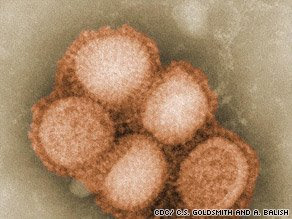
Thursday, July 30, 2009

NYTimes.com: US Swine Flu Plan Would Put Some Ahead for Vaccine

A panel of health experts laid out a plan on Wednesday for vaccinating certain people first in the likely event that not enough swine flu vaccine will be available to immunize every American in time for the expected surge of cases this fall and winter.

The top priority group, 159 million Americans, or about half the population, would include health care workers and emergency medical responders, because their jobs are critical.

It would also include people with the highest risk of complications and severe illness from the new H1N1 virus: pregnant women; children and young adults from 6 months to 24 years; and people ages 25 to 64 with medical problems like asthma, diabetes or heart disease."

NYTimes.com: US Swine Flu Plan Would Put Some Ahead for Vaccine

Friday, July 24, 2009

CDC: Up To 40 Percent Of Americans May Get Ill

U.S. health officials say swine flu could strike up to 40 percent of Americans over the next two years and as many as several hundred thousand could die if a vaccine campaign and other measures aren't successful.

Those estimates from the Centers for Disease Control and Prevention mean about twice the number of people who usually get sick in a normal flu season would be struck by swine flu. Officials said those projections would drop if a new vaccine is ready and widely available, as U.S. officials expect.

The U.S. may have as many as 160 million doses of swine flu vaccine available sometime in October, and U.S. tests of the new vaccine are to start shortly, federal officials said this week.

WBZTV.com: Centers For Disease Control And Prevention Estimates Up To 40 Percent Of Americans May Get Ill

WHO | Pandemic (H1N1) 2009 briefing note 4

The number of human cases of pandemic (H1N1) 2009 is still increasing substantially in many countries, even in countries that have already been affected for some time.

Our understanding of the disease continues to evolve as new countries become affected, as community-level spread extends in already affected countries, and as information is shared globally. Many countries with widespread community transmission have moved to testing only samples of ill persons and have shifted surveillance efforts to monitoring and reporting of trends.

This shift has been recommended by WHO, because as the pandemic progresses, monitoring trends in disease activity can be done better by following trends in illness cases rather than trying to test all ill persons, which can severely stress national resources. It remains a top priority to determine which groups of people are at highest risk of serious disease so steps to best to protect them can be taken.

In addition to surveillance information, WHO is relying on the results of special research and clinical studies and other data provided by countries directly through frequent expert teleconferences on clinical, virological and epidemiological aspects of the pandemic, to gain a global overview of the evolving situation.

WHO | Pandemic (H1N1) 2009 briefing note 4

Al Jazeera English - H1N1 virus spreads to 160 countries

The H1N1 flu virus has spread to at least 160 countries across the world, the World Health Organisation (WHO) has said.

The global virus, which the UN health agency declared a pandemic in June, has resulted in nearly 800 deaths worldwide since it was first detected in Mexico four months ago, WHO officials said in Geneva, Switzerland, on Friday.

'The spread of this virus continues, if you see 160 out of 193 WHO member states now have cases, so we are nearing almost 100 per cent, but not quite yet,' said Gregory Hartl, a WHO spokesman.

'For the moment we haven't seen any changes in the behaviour of the virus,' he said.

'What we are seeing still is a geographic expansion across countries.'

Al Jazeera English - H1N1 virus spreads to 160 countries

Thursday, July 23, 2009

Reuters: U.S. has bought 195 million doses of H1N1 vaccine

The U.S. government has bought 195 million doses of H1N1 swine flu vaccine for a possible autumn vaccination campaign, a U.S. federal official said Thursday.

The U.S. Health and Human Services Department has also contracted for 120 million doses of adjuvant, a compound to stretch the number of doses of vaccine needed, the department's Dr. Robin Robinson told a meeting of Food and Drug Administration advisers.

Five companies are making H1N1 vaccine for the U.S. market -- AstraZeneca's MedImmune unit, Australia's CSL Ltd, GlaxoSmithKline Plc, Novartis AG and Sanofi-Aventis SA.

Earlier, an FDA official said vaccine makers were only getting about 30 percent as much vaccine from eggs as they usually get with seasonal influenza vaccine.

Reuters: U.S. has bought 195 million doses of H1N1 vaccine

CBC News - Health officials: Tamiflu-resistant strain is rare

Health officials say a recent Quebec case of drug-resistant swine flu shouldn't prompt Canada to change its approach to Tamiflu, as the strain remains rare worldwide.

A 60-year-old Quebec man is one of five people around the world found to have a strain of H1N1 flu resistant to the antiviral drug Tamiflu (oseltamivir). The other cases occurred in Japan, Denmark and Hong Kong.

The Quebecer was given a low preventive dose of Tamiflu as a precaution because he had a pulmonary condition and doctors thought he might have been exposed to swine flu.

CBC News - Health officials: Tamiflu-resistant strain is rare

Sky News UK: Swine Flu Latest: 100,000 New Swine Flu Cases Reported In Past Week

One hundred thousand new cases of swine flu have been recorded in the last seven days.

The figure for England is double the total of the previous week.

Some 840 people are described as being 'seriously ill' in hospital with the illness - and 63 people are being treated in intensive care.

The death toll in the UK stands at 31, but that is likely to climb when the Department of Health releases its weekly update online later.

Sky News UK: Swine Flu Latest: 100,000 New Swine Flu Cases Reported In Past Week

ComputerWorld Hong Kong: Swine flu raises telework questions

The possibility of a widespread swine flu outbreak is prompting companies to think about business continuity and how options such as telework or telecommuting may become a necessity.
A recent whitepaper by Nortel Networks on business continuity and teleworking posed the following questions to enterprises:

1. Can your business operate at 60% of its employee capacity?

2. Due to quarantine mandates, can you maintain business operations when you cannot permit your employees to work from their office?

3. How do you continue to conduct business when health officials and your organization have banned your business travel into affected geographical areas?

4. During times of crisis, do you have the capability and capacity to seamlessly communicate status and share information with all stakeholders

Companies that have solid telework plans in place are in good shape, says Chuck Wilsker, president and CEO of the Telework Coalition in the US.
Those that aren’t prepared to have employees work offsite may find operations at a standstill if the swine flu threat were to escalate to the point of widespread absenteeism or building closures.

ComputerWorld Hong Kong: Swine flu raises telework questions

Cartoons


More A/H1N1 cartoons here

CBS News Video: H1N1 Pregnancy Risks

On CBS News dr. Jennifer Ashton spoke with Harry Smith about the heightened flu danger for pregnant women.

CBS News Video: H1N1 Pregnancy Risks

CNN.com: U.S. trials for H1N1 vaccine announced

In a race to beat the flu season, medical institutes across the United States will begin human trials for a new H1N1 flu vaccine starting in early August, the University of Maryland announced Wednesday.
Concern about the H1N1 virus grew after it spread quickly around the globe earlier this year.

Concern about the H1N1 virus grew after it spread quickly around the globe earlier this year.

In the hope of getting the vaccine to those who will need it most by October, the clinical trials will enroll as many as 1,000 adults and children at 10 centers nationwide, said officials at the Center for Vaccine Development at the University of Maryland School of Medicine, which will lead the effort. The trials will measure the safety and effectiveness of the vaccine.

The research is a first step toward U.S. health officials' goal of developing a safe and effective vaccine against H1N1, also known as swine flu, which has been declared a global pandemic by the World Health Organization

The time frame for developing a vaccine is a tight one.

'It's going to be close,' said Dr. Anthony Fauci, director of the National Institute of Allergy and Infectious Diseases at the National Institutes of Health. 'I believe it can be [ready by October] if things run smoothly. We hope they will, but you never can tell when you're dealing with biological phenomena like making vaccines and administering them.'

The announcement of the U.S. trials followed the announcement earlier this week, by an Australian company, CSL Ltd., of the first human trials of a swine flu vaccine.

CNN.com: U.S. trials for H1N1 vaccine announced

Wednesday, July 22, 2009

The Lancet Infectious Diseases: Closure of schools during an influenza pandemic

In response to WHO raising the influenza pandemic alert level from phase five to phase six, health officials around the world are carefully reviewing pandemic mitigation protocols.

School closure (also called class dismissal in North America) is a non-pharmaceutical intervention that is commonly suggested for mitigating influenza pandemics.

Health officials taking the decision to close schools must weigh the potential health benefits of reducing transmission and thus case numbers against high economic and social costs, difficult ethical issues, and the possible disruption of key services such as health care.

Also, if schools are expected to close as a deliberate policy option, or just because of high levels of staff absenteeism, it is important to plan to mitigate the negative features of closure. In this context, there is still debate about if, when, and how school closure policy should be used.

The Lancet published a Review, in which a multidisciplinary and holistic perspective and review the multiple aspects of school closure as a public health policy is taken. Implications for the mitigation of the swine-origin influenza A H1N1 pandemic are also discussed.

The Lancet Infectious Diseases: Closure of schools during an influenza pandemic

AFP: Stay away from Mecca over swine flu, pilgrims warned

Egypt has become the latest country to warn vulnerable Muslims against pilgrimage to Mecca, after an Egyptian woman back from Saudi Arabia became the first swine flu death in the Middle East and Africa.

Egypt's health ministry 'has warned the elderly, pregnant women, children and those suffering from chronic illness not to perform the hajj or omra pilgrimages,' the official MENA news agency reported late Monday.

As well as the annual hajj, which all Muslims are required to make once in a lifetime if they have the means, the faithful can also make a lesser pilgrimage to the holy places, known as omra, at any time of the year.

Upwards of two million people are expected in Saudi Arabia over the next five months on pilgrimages to the Muslim holy cities of Mecca and Medina in the west of the kingdom.

The ministry 'has asked them to delay taking part so that they are not exposed to the risks... of swine flu,' MENA quoted health ministry official Amr Qandil as saying.

The warning came ahead of a meeting of Arab health ministers in Cairo on Wednesday to coordinate arrangements and precautions to be taken during the pilgrimage season.

Egypt on Sunday reported its first death linked to swine flu after a 25-year-old woman returning from a pilgrimage in Saudi Arabia died in hospital.

AFP: Stay away from Mecca over swine flu, pilgrims warned

Saturday, July 18, 2009

Reuters: UK school children quarantined for H1N1 flu in China

A group of 52 British school children and their teachers have been quarantined in Beijing after four pupils were admitted to hospital infected with the H1N1 flu virus, Britain's Foreign Office said Saturday.

(A hospital worker wearing an isolation suit stands
at the entrance of a flu inspection clinic in
Beijing's Ditan Hospital. REUTERS/Jason Lee
)

The group arrived in China earlier this week for a culture and study tour. But shortly after arrival at Beijing airport, four of the students -- all believed to be teenagers -- were admitted to hospital showing symptoms of swine flu infection.

As a precaution, the remainder of the group was quarantined in their four-star hotel in Beijing.

'We can confirm that a group of 52 British school children and teachers are being held in quarantine in their hotel,' a Foreign Office spokeswoman said.

Reuters: UK school children quarantined for H1N1 flu in China

Swine Flu Diary - Melissa Auf der Maur

Photo courtesy of Melissa Auf der Maur

Musician Melissa Auf der Maur, formerly of Hole and the Smashing Pumpkins has Mexican Flu.
She writes in her weblog:

"About two weeks ago, I was reading an article in The Globe and Mail over breakfast, when a question crossed my mind: 'Have I been kissed by the gloom of Swine?'

You might think it’s a shocking or silly question, but I’d been sick on and off for a month. It turns out that, somewhere between a video shoot in Vermont, a heavy metal concert in London, and my own musical showcase in Toronto, I had indeed fallen victim to a world pandemic. I am now officially on the mend – thanks to a combination of naturopathic treatments and heavy-duty antibiotics, among other survival tools – and I’ve gathered enough energy to type out this, my swine flu chronicle."

Swine Flu Diary - Melissa Auf der Maur

Swine flu reports jump by half in a week - Times Online

Influenza graph


The number of swine flu cases has jumped by nearly 50 per cent in a week, figures released yesterday indicate.

Data from a sample of GPs’ surgeries, seen by The Times, shows that up to 40,000 people complained to their doctor last week of “flu-like illness” in England and Wales, with a huge rise in the number of young children being affected.

The report shows that the highest rates of reported illness are in children aged five to 14, with 160 of every 100,000 in this age group reporting symptoms, followed by 114 per 100,000 of the 0 to four-year-olds.

Overall, the rate of people complaining of symptoms increased to 73.4 cases for every 100,000 people in the week to Sunday, compared to 50.3 cases per 100,000 the week before.

Times Online: Swine flu reports jump by half in a week

Edmonton Sun: Swine flu on wane, but health officials anticipate comeback

Three months after Canadian scientists first became aware of a mysterious influenza outbreak in Mexico, the rate of new swine flu cases in this country finally seems to be ebbing.

But public health officials warn the virus will be back with a vengeance in the fall.

'We're still seeing new cases (but) it appears there are fewer,' Dr. David Butler-Jones, Canada's chief public health officer, said yesterday. 'We are seeing fewer people admitted to hospital, so it seems to be on the wane.'

But he added, 'It's an amazing, adaptive disease and it's always full of surprises.'

So full of surprises, apparently, that British officials this week projected a worst-case scenario of up to 65,000 deaths in the U.K. from H1N1. Their bleak assessment included an estimate that 30% of the population could become infected, and that half of British children could contract H1N1.

Edmonton Sun: Swine flu on wane, but health officials anticipate comeback

Thursday, July 16, 2009

WHO stopped tracking swine flu cases

In a move that caught many public health experts by surprise, the WHO quietly announced Thursday that it would stop tracking swine flu cases and deaths around the world," the New York Times reports.

As the 2009 pandemic evolves, the data needed for risk assessment, both within affected countries and at the global level, are also changing.

At this point, further spread of the pandemic, within affected countries and to new countries, is considered inevitable.

This assumption is fully backed by experience. The 2009 influenza pandemic has spread internationally with unprecedented speed. In past pandemics, influenza viruses have needed more than six months to spread as widely as the new H1N1 virus has spread in less than six weeks.

The increasing number of cases in many countries with sustained community transmission is making it extremely difficult, if not impossible, for countries to try and confirm them through laboratory testing. Moreover, the counting of individual cases is now no longer essential in such countries for monitoring either the level or nature of the risk posed by the pandemic virus or to guide implementation of the most appropriate response measures.

WHO | Pandemic (H1N1) 2009 briefing note 3

Monday, July 13, 2009

Ministry of Tourism in Malaysia to brain-storm on fears over A/H1N1

A two-day brain-storming session to tackle the Influenza A (H1N1) issue will be held by the Tourism Ministry of Malaysia today.

The ministry’s officers from 44 locations around the world would be attending the session and come up with strategies to allay fears of the virus and encourage more visitors to the country, said Minister Datuk Seri Dr Ng Yen Yen.

“We need feedback to understand the real situation that we are in now,” Ng said after attending the “Loving Heart Cheongsam Night”, an event organised by the Federation of Hakka Association of Malaysia at the KL & Selangor Chinese Assembly Hall here yesterday.

Ng said the ministry would collaborate with the Federation of Hakka Association to tap the federation’s vast network around the world.

A session with nine selected advertising agencies would also be held to discuss promotional strateties for the country.

“People are afraid to travel these days.

“Each time we lose 10% of our tourists, we will lose an income of RM4.9bil,” she said.

Ministry of Tourism in Malaysia to brain-storm on fears over A/H1N1

The Guardian: Swine flu strikes Downing Street – and almost reaches G8 summit

The first case of swine flu has struck Downing Street and it nearly caused a diplomatic crisis.

Gordon Brown's senior climate change adviser Michael Jacobs was banned from attending the G8 summit in Italy for fear he would pass the contagious disease to Barack Obama and other world leaders.

It is understood that Jacobs contracted the disease while involved in climate change talks in Mexico.

He had travelled to Rome for some preliminary negotiations on the draft of the G8 communique text, and was told by his personal doctor that he was no longer suffering from the disease. He then planned to travel to the conference site in L'Aquila, Italy, but was told by Brown that he could not risk him going.

The Guardian: Swine flu strikes Downing Street – and almost reaches G8 summit